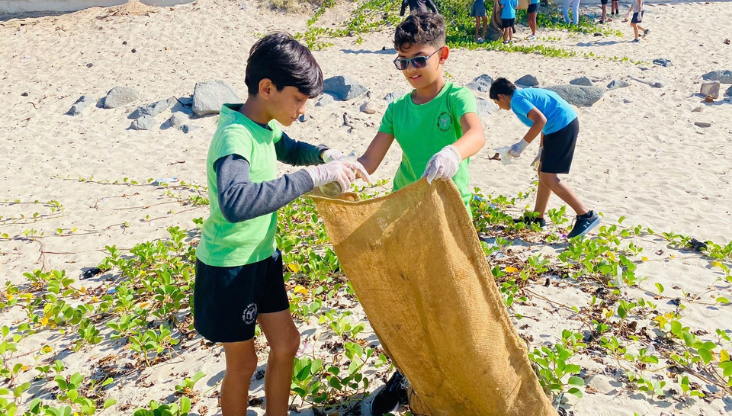
Aga Khan Schools’ students explore climate and environmental challenges
More than 150 Grade 9–12 students from seven countries participated in the fifth annual Aga Khan Schools (AKS) Climate and Environment Conference virtually from 25–26 September 2026. The conference provided an opportunity for students from India, Kenya, the Kyrgyz Republic, Mozambique, Pakistan, Tanzania and Uganda to share their research and ideas, learn from one another, and explore ways of responding to climate and environmental challenges.
The conference began with opening remarks from Prince Aly Muhammad Aga Khan, who emphasised how climate change is a collective effort. He encouraged students to develop their passions, regardless of what they are, and to use them to collaborate with others to support the climate and environment.
“Climate change isn’t just one subject, it doesn’t belong only to climate scientists,” Prince Aly Muhammad said. “It reaches into just about every corner of our lives, which means you can begin just about anywhere. ... Rather than asking yourself what climate career should I have ... I would instead start with a set of questions. What fascinates you? What are you naturally inclined to be good at? And what are you willing to spend years getting better at? And I think you'll see where that takes you.”
Through presentations, discussions and interactive sessions, students explored environmental issues based on this year’s theme, “Climate Change and Food Security”, and considered how knowledge, creativity and collaboration can contribute to addressing them. The presentations included a range of ideas and initiatives to mitigate climate change through fashion, nutrition, agriculture, artificial intelligence and more.
In her presentation, Grade 10 student Jannat Abdul Rahim from the Sultan Mahomed Shah Aga Khan School, Karachi investigated the greenhouse gas emissions of the food served in her school’s canteen. Through her research, she found that the canteen’s current menu, including meats and fried foods, generates approximately 1,600 kilograms of CO₂ per day for 1,000 students. By introducing an alternative vegetarian-based menu, this would bring the CO₂ emissions to approximately 550 kilograms per day, representing a potential saving of 1,050 kilograms of CO₂ per day and more than 250,000 kilograms of CO₂ across a school year.
“Most projects focus on [how] agriculture ... or transportation ... can reduce carbon emissions,” Jannat said. “But I focused on the eating part of the process, and not only did I theorise this, but I also implemented this in the school by swapping out the higher emission choices to the lower emission alternatives.”
The breadth and creativity of the student presentations were highlighted by Dr Rahim Somani, AKS General Manager, in his closing remarks. He also reminded students of the power of the conference and how it can be a starting point for more action taken towards climate change.
“Do not let this conference be the end of something,” Dr Somani said. “Let it be the beginning of something. Take one idea forward. Carry forward one connection you have made. Find one opportunity to work with students from another Aga Khan school or another country and see where it leads. And we, too, will build on what has begun here.”
The conference also featured a panel discussion with AKS alumni and a speech from alumnus Dr Muhammad Zafar Khan, who was the guest speaker. Dr Khan, an associate professor and chair of the Department of Forestry, Range and Wildlife Management at Karakoram International University, attended the Diamond Jubilee Learning Resource High School, Barkulti. The alumni involved in the panel discussion included two alumni from the Aga Khan Academy Mombasa: Raghuveer Vyas, a Class of 2016 alumnus, who is a climate policy analyst and implementation strategist at Climate Analytics in Berlin, Germany; and Simran Khataw, a Class of 2016 alumna, who is a climate change officer at the United Nations Development Programme in Vietnam.
Through this annual conference, AKS continues to cultivate environmental stewardship in its students by providing them with a platform to learn together, share their ideas and consider how they can contribute to addressing environmental challenges.
Learn more about the conference and this year’s student presentations
here.
Watch an excerpt from Prince Aly Muhammad’s opening remarks
here.